Tag: kingston upon thames

  • Inclusion London Event – What Next for Independent Living?

    Secretary Keegan Hillier attended the Inclusion London event, What next for Independent Living?, on Thursday 16th April. The event took place in person at the Coin Street Community Centre in Central London.

    The focus of the day was on understanding the movement out of institutions and imprisonment, and ensuring that disabled people remain able to choose and have a say in their care and living situations.

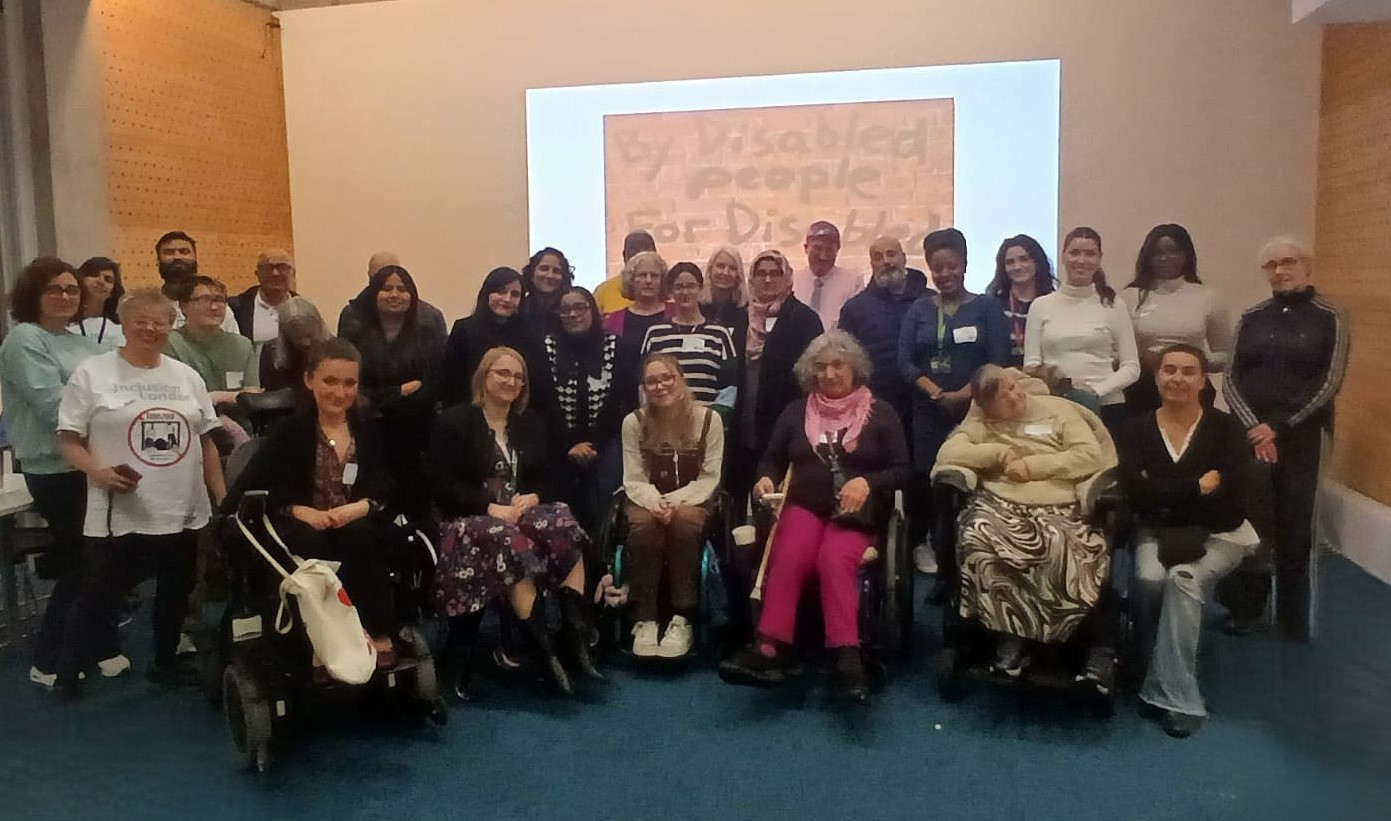
    A photo of attendees from the Inclusion London Event. There is a diverse group of around 30 people, all smiling at the camera.

    As the photo shows, there was a wide range of people from across the capital, with some coming in from even further afield. We hope to invite some of the contacts made to future All Members Meetings to share how schemes from other areas can be applied to and improve accessibility and disability understanding in Kingston upon Thames.

    Keegan’s Key Takeaways from the day were;

    • The Independent Living movement is surprisingly new – the movement began in the late 1960s in America.
      • The UK version was kicked off by John Evans, among other prisoners of institutions, leading up to Project 81, with the UN International Year of Disabled People, 1981, being their target for freedom.
    • In the 1980s, Centres for Independent Living (CILs) and Deaf and Disabled Peoples Organisations (DDPOs) created, and practiced, the concept of self-directed support.
      • This was a radical change at the time, challenging the medical and charitable models of disability in favour of the social model.
      • This was where the move to describing people as Personal Assistants (PAs) over Carers came in, as they assisted with living life.
    • It took until 2007 for the UN Convention on the Rights of Disabled People. This was ratified by the UK government in 2010.
    • Intersectionality was essential, especially in the early days of the Independent Living movement.
      • Panelists explained how the Black Panthers movement in America were very supportive of the ‘Crip Camps’ and other disability organisations and movements that went on in their country. The panelists also raised how women were particularly important in supporting the work of Independent Living activists, especially in its early days.
    • Reflections on what more needs to be done included;
      • Revisions to personal budgets, to allow for greater freedom to provide what disabled people need.
      • Tackling misconceptions of what ‘independence’ means, as what is viewed as independence to able-bodied people is often very different to what is true independence for disabled people.
      • Continuing to speak up when policy and systems are not working. This includes, but is not limited to, advocacy for greater funding into social care, or pushing for more accessible and adaptable affordable and social housing.

    Inclusion London regularly runs campaigns, and events, working to improve accessibility and unite disabled people across London. You can see their current campaigns at the following link – https://www.inclusionlondon.org.uk/campaigns-and-policy/

  • The Fairfield review wants to hear your experiences of the Met Police

    The following is shared on behalf of Inclusion London:

    The Fairfield Independent Review is looking into what the Met Police have done to regain public trust since the Casey Review found serious failings, including shocking ableism from the police. 

    The review wants to hear about your experiences of the Met Police, positive or negative.

    There are three ways to give your views:

    Please also see the article from Inclusion London for more information – https://www.inclusionlondon.org.uk/news/the-fairfield-review-wants-to-hear-your-experiences-of-the-met-police/

  • Job Vacancy: External Communications / Social Media Manager

    This role’s aims and expectations are as follows:

    • Advertise the Kingston Disability Network (KDN) to external bodies through creation of advertisement graphics, social media posts, and attendance of public events
    • Promote a positive image of the Network, whilst keeping an eye out for disability or charity-related events in the Kingston Borough for members of the Executive Committee to attend. The External Comms manager does not have to be the one to attend said events, but is responsible for sharing these events with their Executive Committee peers, ensuring someone is able to attend or that the Secretary sends our apologies for the KDN’s absence.

    The position of External Communications Manager requires someone with an understanding of graphic design, or a passion for learning. It would be well-suited to a university student looking to develop marketable skills, but we welcome applicants from any background. The External Communications Manager will have access to the KDN’s social media pages – currently Twitter/X and a Facebook group – and will use programs like Canva to create eye-catching graphics, keeping in mind the need to include Image Descriptions and dyslexia-friendly fonts. There may also be the need to create event posters and graphics on occasion.

    This role requires someone with some familiarity with disability, whether through personal experience, past employment, or a keen interest in accessibility. The role also requires the role-holder to live or work within, or close to, the Royal Borough of Kingston-Upon-Thames, as the KDN is Kingston-focused. 

    The External Communications role offers fairly flexible working, with the only requirements being a once-monthly meeting (usually hybrid) and once-weekly check-ins with the rest of the Executive Committee. These check-ins can be through casual meet-up, email, or phone, depending on the needs and schedules of all involved. All other work can be completed whenever your schedule suits, and can be moulded to fit around a career, degree, or any other commitments. We expect this role should take no more than 2 hours for the average week, but may have periods requiring up to 5 hours a week, with notice.

    As this role is voluntary, we are unable to pay for any costs or charges the applicant may encounter. However, we do not expect the applicant to pay out of pocket for any premium services, and if these should be required, the KDN will cover costs.

    Those interested in the position should submit a CV and a short text, no more than 500 words, detailing your experience or interest in working as an External Communications officer or for a disability organisation. This can be sent to info@kdn.org.uk. Please also submit any questions to this address, as we are happy to speak to interested applicants.

    Those who are successful in their submissions will be invited to a short, semi-informal interview with the Vice-Chair and Secretary, to discuss suitability for the role and answer any questions you may have.

  • Role vacancy: Treasurer

    This role’s aims and expectations are as follows:

    • Manage the finances of the Kingston Disability Network (KDN)
    • Work alongside the Executive Committee and Steering Group to apply for charitable grants and community group funding

    The position of treasurer requires someone who is comfortable with numbers and finances. Prior treasurer experience is not required, but if you lack the current experience, we ask for a proactive passion for learning. The treasurer will have access to the KDN’s banking, alongside the Vice-Chair and Secretary, and will offer sensible budgeting ideas for events, activities, and running costs. The Treasurer will create spreadsheets covering the KDN’s regular costs, ongoing fees, and streams of income, offering all relevant bodies an understanding of the ins and outs of the KDN’s financial status.

    This role requests someone with some familiarity with disability, whether through personal experience, past employment, or a keen interest in accessibility. The role also requires the role-holder to live within, or close to, the Royal Borough of Kingston-Upon-Thames, as the KDN is Kingston-focused. 

    The Treasurer role offers fairly flexible working, with the only requirements being a once-monthly meeting (usually hybrid) and once-weekly check-ins with the rest of the Executive Committee. These check-ins can be through casual meet-up, email, or phone, depending on the needs and schedules of all involved. All other work can be completed whenever your schedule suits, and can be moulded to fit around a career, degree, or any other commitments, and is expected to be no more than a few hours a week, often less.

    As this role is voluntary, we are unable to pay for any costs or charges the applicant may encounter. However, we do not expect the successful applicant to pay for any applications necessary for the treasurer role, and covering the cost of these can be discussed should any come up.

    Those interested in the position should submit a CV and a short text, no more than 500 words, detailing your experience or interest in working as a treasurer or for a disability organisation. This can be sent to info@kdn.org.uk. Please also submit any questions to this address, as we are happy to speak to interested applicants.

    Those who are successful in their submissions will be invited to a short, semi-informal interview with the Vice-Chair and Secretary, to discuss suitability for the role and answer any questions you may have.